
In the global beverage industry, one of the most important factors influencing production decisions is Minimum Order Quantity (MOQ). For brands working with Fruit Juice OEM Services, understanding MOQ is essential for cost control, inventory planning, and market entry strategy. Whether you are a startup launching a new product or an established company expanding your portfolio, MOQ directly impacts your investment, pricing, and operational efficiency.
Fruit Juice OEM Services manufacturers typically set MOQ requirements to ensure production efficiency, optimize resource utilization, and maintain profitability. However, these requirements can vary depending on factors such as product type, packaging format, customization level, and production technology. For many businesses, navigating MOQ can be challenging, especially when balancing budget constraints with growth ambitions.
This article provides a comprehensive guide to Minimum Order Quantities in Fruit Juice OEM Services, explaining how MOQ works, what factors influence it, and how brands can optimize their strategies to achieve successful and scalable production.
1. Understanding Minimum Order Quantities in OEM Manufacturing
Understanding Minimum Order Quantities in OEM Manufacturing
Minimum Order Quantity is a fundamental concept in OEM manufacturing that determines the smallest number of units a manufacturer is willing to produce in a single order.
What is MOQ in Fruit Juice OEM Services?
In the context of Fruit Juice OEM Services, MOQ refers to the minimum volume of juice products that a manufacturer requires per production batch. This could be measured in liters, bottles, cartons, or pallets, depending on the production setup.
MOQ ensures that production runs are economically viable for the manufacturer. It helps cover fixed costs such as equipment setup, labor, and quality control processes.
Why OEM Providers Set MOQ
OEM manufacturers invest significant resources in each production run. Setting an MOQ allows them to optimize these resources and maintain operational efficiency.
Without MOQ, small orders could lead to higher production costs per unit, making it difficult for manufacturers to sustain profitability.
Impact on Business Planning
For brands, MOQ plays a crucial role in planning production, budgeting, and inventory management. Understanding MOQ helps businesses determine how much capital is required and how quickly products need to be sold.
A clear understanding of MOQ enables brands to align their production strategy with their market goals.
2. Factors That Influence MOQ in Fruit Juice OEM Services
MOQ is not fixed and can vary based on several factors related to production and product specifications.
Product Type and Formulation
Different types of fruit juice products require different production processes. For example, NFC (Not From Concentrate) juice, concentrate-based juice, and functional beverages may have varying MOQ requirements.
Complex formulations with multiple ingredients or specialized processing methods often result in higher MOQ.
Packaging Format and Design
Packaging plays a significant role in determining MOQ. Custom packaging, such as unique bottle shapes or specialized labeling, may require larger production volumes.
Standard packaging options typically have lower MOQ, making them more suitable for small-scale production.
Production Technology and Equipment
The type of equipment used in production also affects MOQ. High-capacity automated lines are designed for large-scale production and may require higher minimum orders.
In contrast, smaller or flexible production lines can accommodate lower MOQ, but may have higher per-unit costs.
3. Cost Implications of MOQ for Beverage Brands
Cost Implications of MOQ for Beverage Brands
Understanding the cost implications of MOQ is essential for effective financial planning.
Fixed and Variable Costs
Production costs include both fixed and variable components. Fixed costs, such as equipment setup and labor, are spread across the total production volume.
Higher MOQ helps reduce the cost per unit by distributing fixed costs over a larger quantity.
Pricing Strategy and Profit Margins
MOQ directly impacts pricing strategy. Larger orders typically result in lower unit costs, allowing brands to achieve better profit margins.
However, high MOQ also requires higher upfront investment, which can be challenging for smaller businesses.
Inventory and Storage Costs
Producing large quantities means storing more inventory. This can lead to additional costs related to warehousing and logistics.
Brands must balance MOQ with their ability to manage inventory efficiently.
4. MOQ and Market Entry Strategy
MOQ plays a critical role in determining how quickly and effectively a brand can enter the market.
Challenges for Startups
Startups often face difficulties meeting high MOQ requirements due to limited budgets and uncertain demand.
This can create barriers to entry and increase financial risk.
Strategies for Managing MOQ
Brands can adopt various strategies to manage MOQ, such as starting with standard formulations, choosing flexible packaging options, or partnering with OEM providers that offer lower MOQ.
These approaches help reduce initial investment and risk.
Testing and Validation
Before committing to large orders, businesses should test their products in the market. This can be done through small pilot runs or limited releases.
Testing helps validate demand and refine the product before scaling production.
5. Flexibility and Negotiation with OEM Providers
Flexibility and Negotiation with OEM Providers
MOQ is often negotiable, depending on the relationship between the brand and the OEM provider.
Building Strong Relationships
Establishing a strong partnership with an OEM provider can lead to more flexible MOQ terms. Long-term collaboration and consistent orders may encourage manufacturers to accommodate smaller quantities.
Trust and communication play a key role in this process.
Custom Solutions for Different Needs
Some OEM providers offer customized solutions to meet specific business needs. This may include flexible production schedules or shared production runs.
These solutions help brands optimize their production strategy.
Balancing Flexibility and Cost
While lower MOQ provides flexibility, it may result in higher per-unit costs. Businesses must evaluate the trade-offs and choose the option that best aligns with their goals.
6. Scaling Production Beyond MOQ Limitations
As a brand grows, its approach to MOQ should evolve to support expansion.
Increasing Order Volumes
With growing demand, brands can increase their order volumes to achieve better economies of scale. This reduces unit costs and improves profitability.
Scaling production is a natural progression for successful products.
Optimizing Supply Chain Management
Efficient supply chain management helps brands handle larger volumes and reduce costs. This includes optimizing logistics, storage, and distribution.
A well-managed supply chain supports sustainable growth.
Leveraging OEM Expertise
Fruit Juice OEM Services providers have the experience and resources to support scaling. They can offer insights into production optimization and cost reduction.
Partnering with an experienced OEM provider ensures smooth expansion.
7. Choosing the Right OEM Partner for MOQ Efficiency
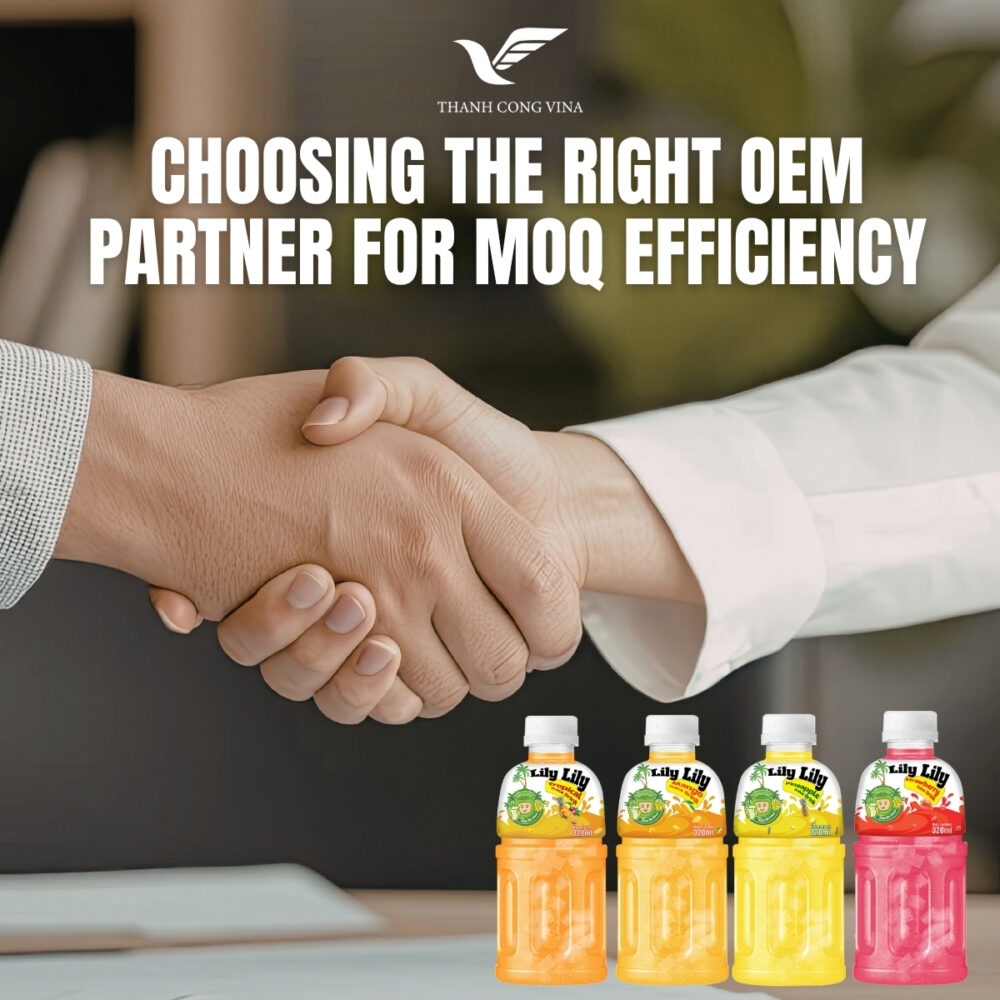
Choosing the Right OEM Partner for MOQ Efficiency
Selecting the right OEM partner is essential for managing MOQ effectively.
Evaluating Production Capabilities
Brands should assess the production capacity and flexibility of the OEM provider. A capable partner can accommodate varying order sizes and support growth.
This ensures that production aligns with business needs.
Reviewing Cost Structures
Understanding the cost structure of the OEM provider helps businesses make informed decisions. Transparent pricing and clear terms are essential.
This reduces the risk of unexpected expenses.
Long-Term Partnership Benefits
A reliable OEM partner provides ongoing support and flexibility. Long-term partnerships lead to better collaboration and improved efficiency.
Choosing the right partner is key to optimizing MOQ and achieving business success.
Conclusion
Minimum Order Quantity is a critical factor in the success of any beverage production strategy. Fruit Juice OEM Services provide structured MOQ systems that ensure efficient production while balancing cost and scalability. By understanding how MOQ works and adopting effective strategies, brands can optimize their operations, reduce risks, and achieve sustainable growth.
Thanh Cong Vina is a trusted partner in delivering professional Fruit Juice OEM Services with flexible MOQ solutions tailored to different business needs. With advanced production capabilities, transparent processes, and a commitment to quality, Thanh Cong Vina supports brands in managing production efficiently. By partnering with Thanh Cong Vina, businesses can leverage expert guidance and scalable solutions to succeed in the competitive global beverage market through reliable Fruit Juice OEM Services.