
Launching a beverage brand requires more than an innovative recipe and attractive packaging. Entrepreneurs must also consider manufacturing costs, ingredient sourcing, product quality, packaging requirements, and distribution strategies. For startups with limited capital, finding the right beverage manufacturer is an important step toward turning a product concept into a commercially viable business.
Vietnam has become an attractive destination for beverage sourcing, offering access to tropical ingredients, established food processing capabilities, and a growing manufacturing industry. By partnering with an experienced beverage manufacturer, startups can explore different beverage categories, develop products under their own brands, and prepare for expansion into domestic and international markets without investing in their own production facilities.
However, choosing a manufacturing partner involves more than comparing quotations. Businesses need to understand minimum order quantities, production requirements, packaging commitments, and the differences between product sampling and commercial manufacturing.
This guide explains how startups can evaluate beverage manufacturers, manage their first production run, and build a practical foundation for long-term business growth.
1. Why Startups Need the Right Beverage Manufacturer
Why Startups Need the Right Beverage Manufacturer
For an emerging beverage brand, manufacturing decisions can significantly influence profitability, product quality, and the ability to respond to market demand.
Building an independent production facility requires substantial investment in equipment, production space, personnel, quality management, and regulatory compliance. These expenses can create unnecessary financial pressure before a startup has established a reliable customer base.
Working with a third-party beverage manufacturer offers an alternative. Businesses can use existing manufacturing infrastructure and technical expertise while concentrating on product positioning, marketing, sales, and distribution.
Reduce Initial Investment
A manufacturing partnership allows startups to avoid many of the fixed costs associated with operating a factory. Instead of purchasing filling equipment and hiring a complete production team, businesses pay for agreed manufacturing services and materials.
The actual investment depends on the product formula, packaging format, order quantity, and scope of services.
Startups should also budget for product development, testing, artwork, transportation, marketing, and inventory management. Evaluating the complete project cost provides a more realistic picture of the capital required to launch a beverage brand.
Access Manufacturing Expertise
An experienced beverage manufacturer can help businesses assess whether a product concept is technically feasible for commercial production.
This may include evaluating ingredient compatibility, processing requirements, filling methods, packaging materials, and product stability.
Technical guidance is particularly valuable for startups that have developed a recipe at home or in a small laboratory but have not yet tested it on industrial equipment.
A formulation that performs well in a small sample may behave differently during large-scale processing. Working with a qualified manufacturing partner helps identify potential issues before they affect commercial inventory.
Build a Foundation for Growth
A startup’s first production run should support both immediate sales and future expansion.
The ideal manufacturing partner can explain how product specifications, packaging choices, and order volumes influence production costs. This information helps businesses prepare for repeat orders and evaluate the financial implications of scaling up.
By establishing clear specifications and quality requirements early, startups can build a more consistent production process as their brands grow.
2. Understanding Minimum Order Quantities for Beverage Manufacturing
Minimum order quantity, commonly known as MOQ, refers to the smallest quantity a manufacturer agrees to produce for a particular product or order.
For startups, MOQ is one of the most important factors when selecting a beverage manufacturer. A large initial order can increase inventory costs, tie up working capital, and create additional risks if consumer demand develops more slowly than expected.
However, minimum quantities are not determined by the filling line alone. Packaging suppliers, ingredient procurement, production preparation, and quality control can all influence the minimum economically viable order.
Why Beverage Manufacturers Set MOQs
Commercial beverage production involves several costs that remain relatively stable regardless of batch size.
These may include equipment preparation, line cleaning, production changeovers, quality checks, and packaging setup. When the production quantity is small, these costs are distributed across fewer units, increasing the manufacturing cost per bottle or can.
Packaging can create additional restrictions. Suppliers of printed cans, customized bottles, shrink sleeves, labels, and cartons may establish their own minimum purchasing quantities.
As a result, a manufacturer may be technically capable of producing a smaller batch but unable to offer an economical price under the requested packaging arrangement.
Understanding these factors helps startups identify which parts of the production plan can be adjusted to improve affordability.
How Startups Can Manage MOQ Requirements
Although minimum quantities vary between manufacturers and product formats, several strategies can help startups manage their first commercial order.
Choose standard packaging. Using an existing bottle, can, or closure may reduce the need for customized tooling and specialized purchasing arrangements.
Start with one flavor. Launching a single product can simplify production planning and avoid dividing packaging orders across several variants.
Consider simpler decoration. Standard packaging combined with an appropriate label may reduce the initial commitment associated with custom-printed packaging.
Discuss flexible scheduling. Depending on the facility, accepting an available production window may provide more flexibility than requesting a specific date.
Confirm the packaging requirements early. Understanding supplier minimums before approving artwork can help prevent unnecessary material purchases.
These options should be discussed directly with the manufacturer. Not every production facility offers the same flexibility, and the final MOQ must be confirmed for the specific product, packaging format, and production process.
3. Choosing the Right Beverage Product for Your Startup
Choosing the Right Beverage Product for Your Startup
Product selection affects manufacturing feasibility, pricing, packaging, shelf life, and market positioning. Startups should therefore evaluate product ideas against both consumer demand and production requirements.
Rather than launching numerous beverages simultaneously, businesses may benefit from concentrating on a clearly defined product concept.
Fruit Juice and Tropical Fruit Beverages
Fruit juice drinks offer opportunities for brands seeking refreshing flavors and convenient ready-to-drink products.
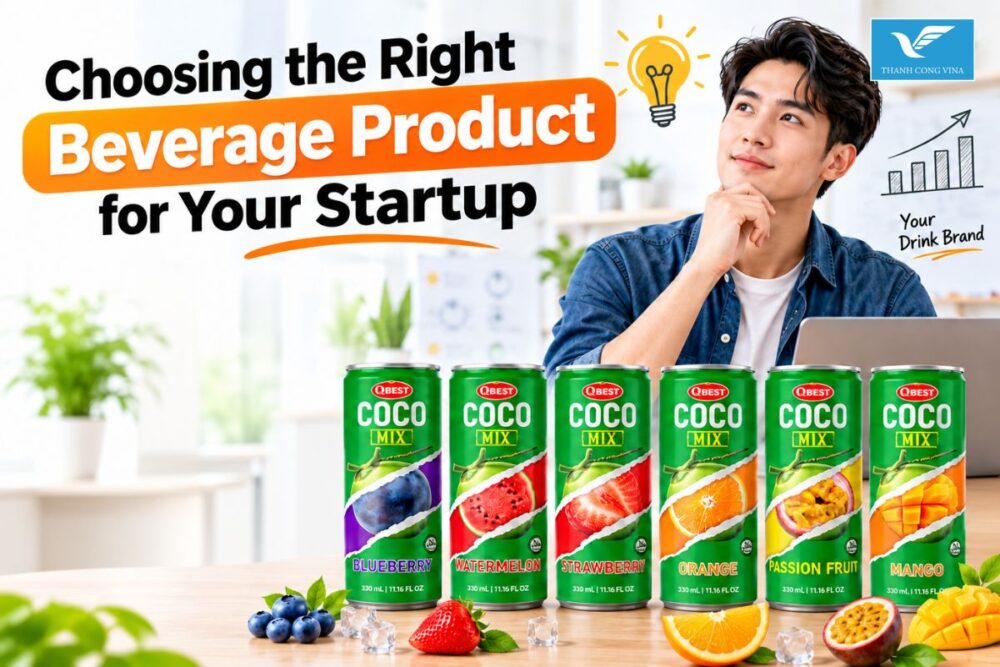
Depending on the target market and manufacturing capabilities, startups may explore beverages featuring mango, pineapple, orange, passion fruit, or other fruit ingredients.
Vietnam’s tropical agricultural resources also make fruit-based beverages an interesting category for businesses targeting international consumers.
When developing a product, startups should evaluate the desired flavor profile, sweetness level, ingredient specifications, processing requirements, and applicable labeling rules.
Coconut Water and Coconut-Based Drinks
Coconut water is another category that can support tropical beverage positioning.
Businesses may consider pure coconut water or product concepts combining coconut water with selected fruit flavors and other compatible ingredients.
Packaging and processing decisions should reflect the beverage’s composition and required storage conditions. Brands should also evaluate how the product will be transported, displayed, and consumed in the target market.
Aloe Vera, Tea, and Other Ready-to-Drink Beverages
Startups can also explore aloe vera drinks, tea beverages, nata de coco drinks, and coffee-based products.
Each category presents different manufacturing considerations. For example, beverages containing suspended ingredients or pieces may require additional attention to texture, ingredient distribution, filling equipment, and product stability.
Before committing to commercial production, businesses should work with the manufacturer to determine whether the proposed formulation is compatible with the available processing technology.
The most suitable starting product is not necessarily the most complicated or innovative concept. It is one that combines a clear market opportunity with a feasible manufacturing process and a sustainable cost structure.
4. OEM, ODM, and Private Label: Which Manufacturing Model Is Right for You?
A beverage manufacturer may offer several collaboration models. Understanding their differences helps startups select a service that matches their product development stage.
OEM Beverage Manufacturing
Original Equipment Manufacturing, or OEM, generally involves producing beverages according to specifications supplied or approved by the brand owner.
This model can suit businesses that already have an established formula and need a manufacturing partner to produce the product under their brand.
Startups should prepare relevant product specifications, ingredient information, quality requirements, and packaging details before requesting a quotation.
The manufacturer can then assess production feasibility and determine whether adjustments or additional trials are necessary.
ODM Beverage Manufacturing
Original Design Manufacturing, or ODM, may involve a broader development process in which the manufacturer helps create or refine a beverage formulation based on the customer’s requirements.
This approach can be useful for entrepreneurs who have a product concept but need technical assistance to develop a commercially suitable formula.
Depending on the agreement, development services may include flavor adjustments, ingredient selection, sample preparation, and packaging recommendations.
Before proceeding, businesses should clarify formula ownership, confidentiality, development fees, and the responsibilities of each party.
Private Label Beverage Solutions
Private label manufacturing allows businesses to sell products under their own brand using products or formulations already available from a manufacturer.
This can provide a practical starting point for entrepreneurs who want to concentrate on branding, sales, and distribution rather than developing a completely new formula.
The available products, customization options, and minimum order quantities depend on the manufacturer’s portfolio and commercial terms.
For startups, comparing OEM, ODM, and private label solutions can reveal different ways to enter the beverage market without building an independent factory.
5. How to Evaluate Beverage Manufacturing Costs
How to Evaluate Beverage Manufacturing Costs
A competitive unit price does not automatically mean a project is profitable. Startups need to understand how production volume, packaging, and other expenses contribute to the total cost of bringing a beverage to market.
Understand the Main Cost Components
Beverage manufacturing costs generally include ingredients, packaging materials, processing, filling, quality control, and secondary packaging.
Additional expenses may include formulation development, laboratory testing, artwork preparation, transportation, export documentation, and warehousing.
Some costs increase directly with production volume, while others are incurred before production begins. Packaging printing and equipment preparation, for example, may involve fixed commitments that have a disproportionate impact on small orders.
Requesting a detailed quotation helps businesses identify these cost components and compare alternative production scenarios.
Calculate the Full Cost per Unit
Startups should calculate the estimated cost of a saleable unit rather than relying exclusively on the manufacturer’s production price.
A practical calculation is:
Total landed product cost per unit = Total attributable product, packaging, manufacturing, logistics, and import costs ÷ Number of saleable units received.
For export projects, applicable duties, taxes, customs charges, and other destination-specific expenses should be considered where relevant.
The calculation should also account for expected losses, damaged packaging, promotional samples, and other inventory that cannot be sold at the regular retail price.
Evaluate Profitability Before Increasing Volume
A larger order may reduce the manufacturing cost per unit, but it also requires more working capital and creates additional inventory exposure.
Before increasing order quantities, startups should estimate their expected selling price, distribution margins, marketing expenses, and realistic sales velocity.
A product is commercially attractive when its economics remain viable after accounting for the full route to market, not simply because a manufacturer offers a lower unit price for a larger order.
6. From Product Idea to Commercial Production
A structured production process helps startups reduce avoidable delays and prepare products for market more efficiently.
Step 1: Define the Product Brief
Prepare a clear description of the beverage, including its category, target consumers, flavor profile, preferred ingredients, serving size, packaging format, and intended sales market.
If a formula already exists, provide the available specifications and reference samples through an agreed confidential process.
Step 2: Assess Manufacturing Feasibility
The beverage manufacturer evaluates the proposed product against available equipment, processing requirements, ingredients, and packaging options.
This stage should also identify any technical limitations or regulatory considerations that could affect product development.
Step 3: Develop and Approve Samples
Where product development is required, samples allow the brand to assess flavor, appearance, texture, and other relevant characteristics.
Sample approval should be based on agreed specifications rather than subjective impressions alone.
Step 4: Finalize Packaging and Documentation
Confirm the package format, artwork, ingredient declaration, nutrition information, and other labeling details required for the destination market.
Packaging decisions should be finalized with sufficient time for material procurement and production scheduling.
Step 5: Confirm the Commercial Order
Before production begins, agree on the order quantity, price, payment terms, delivery conditions, quality specifications, and estimated schedule.
Both parties should understand how changes to the formula, packaging, or order quantity may affect cost and timing.
Step 6: Prepare for Distribution and Reordering
Once production is completed and the applicable quality release requirements are satisfied, the products can be prepared for delivery according to the agreed logistics arrangements.
Startups should monitor sales, inventory levels, customer feedback, and product performance to determine the appropriate timing and quantity for repeat orders.
7. Why Partner with Thanh Cong Vina?
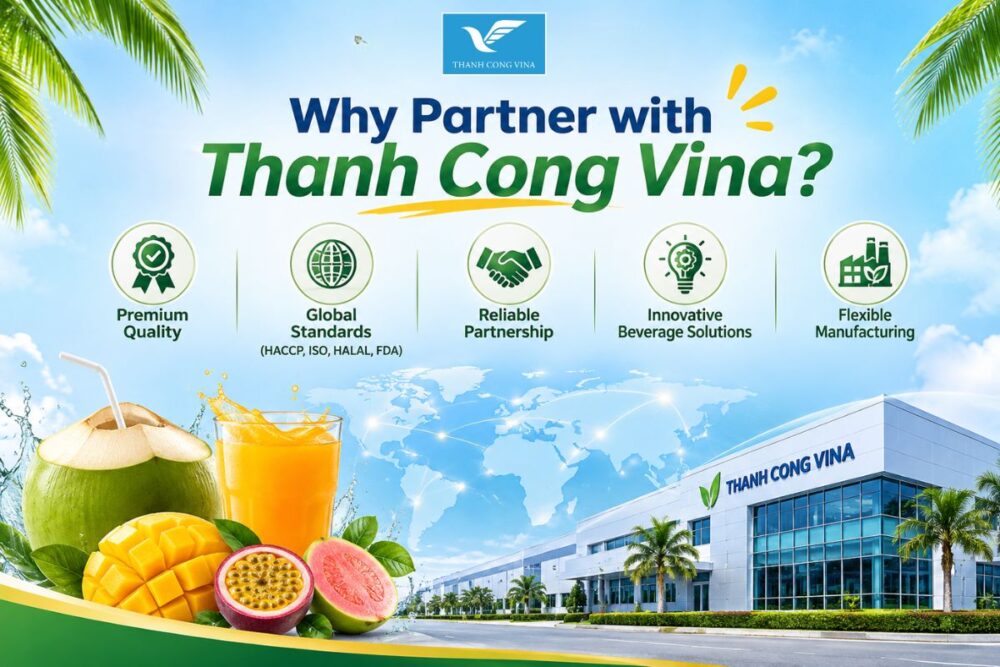
Why Partner with Thanh Cong Vina?
Choosing a suitable beverage manufacturer is an important decision for businesses seeking to develop new products and establish a reliable supply chain.
Thanh Cong Vina provides beverage manufacturing solutions for B2B customers, including importers, distributors, retailers, and brands looking to expand their beverage portfolios.
Its product range includes coconut water, fruit juice drinks, aloe vera beverages, nata de coco drinks, coffee beverages, and other ready-to-drink products.
For startups and established businesses, working with a beverage manufacturing partner can help simplify production planning while allowing internal teams to focus on brand development, marketing, and sales.
When evaluating a project, Thanh Cong Vina can assess the customer’s product concept, target market, packaging preferences, and expected order volume to determine the appropriate manufacturing approach.
Businesses should confirm the available production formats, minimum order quantities, lead times, and product-specific requirements before finalizing their plans.
A successful manufacturing relationship also depends on clear communication, agreed quality specifications, transparent commercial terms, and realistic production schedules.
By establishing these foundations early, beverage brands can create a more structured path from product development to commercial distribution.
Frequently Asked Questions About Beverage Manufacturers
How Do I Find the Right Beverage Manufacturer for a Startup?
Start by identifying manufacturers with experience in your beverage category. Evaluate their production capabilities, quality management systems, packaging options, minimum order quantities, communication processes, and export experience where relevant.
Request a quotation based on a defined product brief so that you can compare suppliers on equivalent requirements.
Can a Startup Work with a Beverage Manufacturer Without Owning a Factory?
Yes. OEM, ODM, contract manufacturing, and private label arrangements allow businesses to outsource production to an appropriate manufacturing partner.
The startup can focus on brand development and sales while the manufacturer handles the agreed production responsibilities.
What Is the Minimum Order Quantity for Beverage Manufacturing?
There is no universal MOQ for every beverage manufacturer. Minimum quantities depend on the product, production equipment, packaging format, ingredient sourcing, and manufacturing economics.
Startups should request confirmation of the MOQ for their exact product and ask whether alternative packaging or production arrangements are available.
How Long Does It Take to Launch a Beverage Product?
The timeline varies according to formulation development, sampling, packaging procurement, artwork approval, regulatory requirements, and production scheduling.
Products based on existing formulations and standard packaging may require fewer development steps than beverages involving new formulas or customized packaging.
A realistic timeline should include both pre-production preparation and commercial manufacturing.
Should Startups Choose the Lowest-Cost Beverage Manufacturer?
Not necessarily. Price should be evaluated alongside product quality, manufacturing consistency, communication, technical capability, delivery reliability, and total landed cost.
A slightly higher quotation may provide better overall value if it reduces production risks or supports more consistent product specifications.
Conclusion
Finding the right beverage manufacturer is a critical step for startups looking to transform an idea into a market-ready product. By understanding minimum order quantities, selecting an appropriate manufacturing model, evaluating the full cost structure, and preparing a clear product brief, entrepreneurs can make more informed decisions about their first commercial production run.
Starting with a focused product portfolio and practical packaging choices can help businesses manage their initial investment while gathering valuable market feedback. As sales become more predictable, brands can refine their products, optimize production volumes, and develop a more scalable supply strategy.
Thanh Cong Vina IEP Co,. LTD supports B2B customers seeking beverage manufacturing solutions for domestic and international markets. Whether you are developing a new beverage concept or expanding an existing product portfolio, choosing a manufacturing partner that understands your specifications and business objectives can help establish a stronger foundation for long-term growth.
Contact Thanh Cong Vina to discuss your beverage concept, manufacturing requirements, packaging options, and potential partnership opportunities.